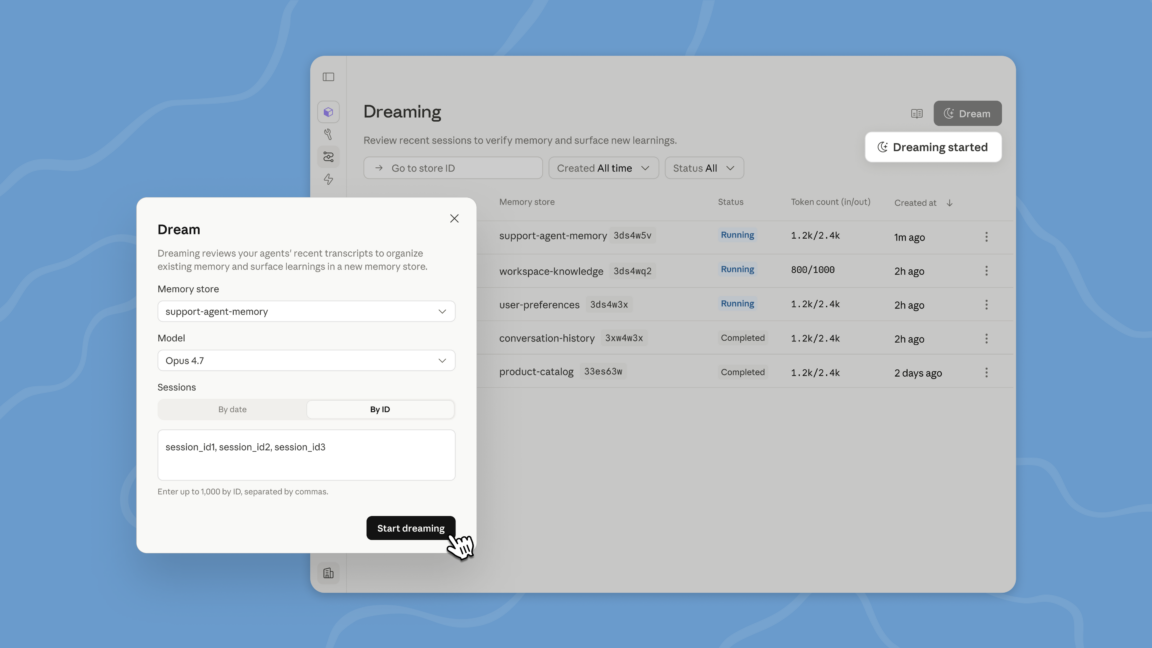
In an era where generative AI is rapidly evolving, Anthropic has taken a bold step forward with its Claude Managed Agents by introducing a feature that enables the AI to "dream." This capability is particularly significant as it allows the agents to engage in a form of predictive reasoning, simulating potential scenarios that enhance their decision-making processes. As developers and engineers in the AI field, understanding how this new functionality can be integrated into existing architectures is crucial for leveraging its potential in real-world applications.
The "dreaming" feature is not just a catchy term; it employs advanced algorithms that allow the Claude agents to generate hypothetical future states based on their current knowledge and past experiences. This involves the use of neural networks that can extrapolate from their training data, effectively allowing them to create a narrative of probable outcomes. This is achieved through a combination of reinforcement learning and large language model capabilities, which together create a feedback loop that refines the agent's predictions over time. Developers can utilize this API to enhance applications that require foresight and adaptability, such as autonomous systems, predictive analytics, and complex decision-making frameworks.
Alongside the introduction of this innovative feature, Anthropic has also announced an expansion of usage limits for its Pro and Max subscribers. The previous five-hour usage cap will double, allowing users to engage with the AI more extensively and efficiently. This increase not only benefits developers by providing them with more time to experiment and iterate but also enhances the overall value proposition of the Claude platform. With this flexibility, projects that require prolonged interactions with AI can be more thoroughly explored, potentially leading to breakthroughs in various domains.
In the broader AI landscape, this development aligns with a growing trend among AI firms to enhance the capabilities of their systems through more sophisticated features. As competitors race to innovate, features like "dreaming" could become a defining characteristic that sets Anthropic apart. Other companies are also investing in similar predictive functionalities, fostering a competitive environment that ultimately drives advancements in AI technology.
CuraFeed Take: The introduction of "dreaming" capabilities in Claude Managed Agents marks a pivotal moment for Anthropic, positioning it as a frontrunner in AI innovation. This feature not only enhances the agents' ability to simulate and predict outcomes but also opens the door for developers to create more responsive and intelligent applications. As the AI landscape continues to evolve, it will be essential to monitor how these advancements impact user engagement and the competitive dynamics within the industry. Developers should keep an eye on how this technology is adopted across different sectors, as it could significantly alter the way AI is integrated into business processes and decision-making frameworks.