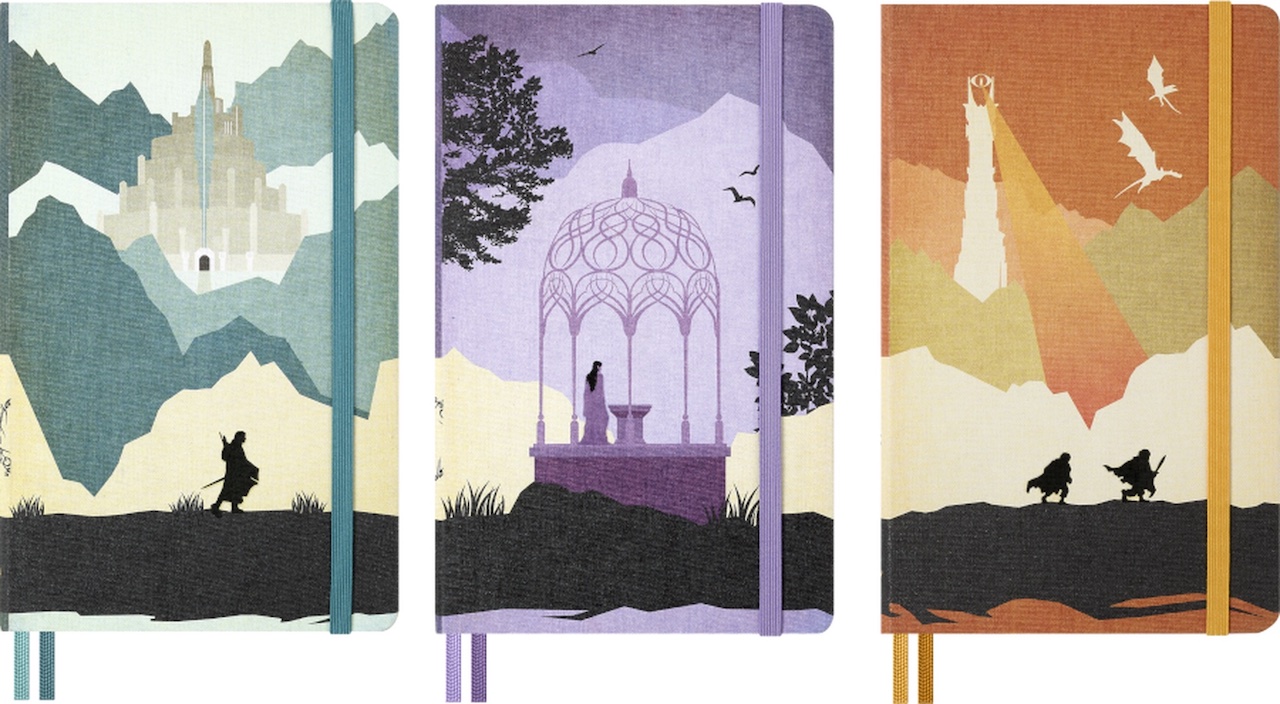
The collision between consumer product design and generative AI just produced another cautionary tale. Moleskine's recent foray into AI-assisted notebook design—specifically a Lord of the Rings collection—demonstrates why shipping AI-generated content without robust guardrails remains fundamentally risky, even for established brands with significant QA resources.
At its core, this represents a failure in the prompt engineering and model selection pipeline. When tasked with creating LOTR-themed designs, the underlying generative systems (likely a combination of text-to-image models like DALL-E or Midjourney, potentially paired with LLM-generated descriptive text) produced outputs that were technically competent but semantically incoherent. The generated imagery and copy missed essential elements of Tolkien's world-building: architectural styles, character aesthetics, thematic consistency, and narrative logic all fell short of what even casual fans would recognize as authentic.
From an architectural perspective, this failure reveals several technical vulnerabilities in current generative pipelines. First, there's the context window problem—even modern LLMs with extended context windows struggle to maintain coherent understanding across complex fictional universes with established canon, visual language, and thematic constraints. Second, training data bias likely played a role; models trained on internet-scale data may have insufficient representation of Tolkien's specific aesthetic choices, creating a "uncanny valley" effect where outputs are recognizable but fundamentally wrong. Third, there's the absence of semantic validation layers—no intermediate step that checks whether generated content actually aligns with the source material's established rules and visual vocabulary.
The technical community's response on Hacker News and similar forums underscores a growing consensus: generative AI excels at producing statistically probable outputs based on training data, but it cannot reliably handle tasks requiring deep understanding of bounded narrative systems. This is particularly acute for intellectual property applications, where licensing holders need content that respects established canon. A DALL-E prompt like "Lord of the Rings aesthetic, Elvish architecture" will generate something visually coherent, but it won't generate something that Tolkien scholars or dedicated fans would recognize as authentic Middle-earth design language.
Consider the architectural implications: Elven structures in Tolkien's work follow specific principles—organic integration with natural environments, particular geometric patterns, material choices informed by the First Age. An image generation model trained on generic "fantasy architecture" will miss these specifics entirely. Similarly, character design, costume details, and symbolic elements all require the kind of granular contextual understanding that current models simply cannot reliably produce without explicit constraint systems.
This incident also exposes the gap between generative capability and generative reliability. A model might occasionally produce something acceptable through sheer probabilistic luck, but there's no systematic way to ensure consistent output quality for bounded, high-fidelity use cases. This is why companies attempting to scale AI-generated content at volume—whether notebooks, greeting cards, or merchandise—keep hitting the same wall: you can automate the generation, but you cannot automate quality assurance for culturally or narratively sensitive applications.
The economic angle matters too. Moleskine presumably chose this approach to reduce design costs and accelerate time-to-market. But the reputational cost of shipping subpar AI-generated products to consumers who expect authentic LOTR designs likely exceeded whatever savings the automated pipeline provided. This is a valuable data point for other brands considering similar strategies: the economics only work if you're willing to accept lower quality standards or if your use case doesn't require deep contextual understanding.
CuraFeed Take: This is a textbook example of applying the wrong tool to the problem. Generative AI works well for tasks where statistical probability aligns with desired output—stock imagery, generic design variations, content at massive scale where quality variance is acceptable. It fails catastrophically when applied to constrained domains with established rules and high fidelity requirements. The real lesson for developers building with AI isn't "don't use generative models for creative work," but rather "understand where the probabilistic approach breaks down and build validation layers accordingly." For Moleskine and similar companies, the path forward requires either: (1) using generative models as inspiration/acceleration tools with human expert review, (2) fine-tuning models on canonical source material with explicit constraint systems, or (3) accepting that certain applications require traditional design workflows. The market will increasingly punish companies that try to ship unvalidated AI output, particularly in IP-sensitive domains. Watch for the emergence of specialized fine-tuned models trained specifically on canonical IP—that's where the real value will accrue.